Exhibition brochure

A GENEROUS VISION
A Major Gift of Works by Mychajlo Moroz

Regensburg at Noontime
1949, oil on board
9 1/2 x 14 in. (24.1 x 35.6 cm)

Mychajlo Moroz (1904–1992) belongs to the preeminent rank of Ukrainian artists of the 20th century. The present exhibition celebrates not only his achievements but also the exceptional generosity of Irena Moroz, the artist’s widow, who in December of 2007 donated 127 of his paintings to The Ukrainian Museum. The exhibition has been drawn exclusively from these works in order to underscore this memorable gift, which, together with other Moroz paintings in the Museum’s permanent collection — earlier gifts from the Moroz family and other generous donors —has made The Ukrainian Museum the largest repository of the artist’s works in the world.

Dusk, Evening Prayer
(Schoharie River)

1966, oil on board
14 x 18 in. (35.6 x 45.7 cm)

More than ten years ago, in 1998, the Museum had initiated the program “In Celebration of Private Collectors.” The present exhibition builds on that legacy by launching a series of exhibitions dedicated to collectors whose generous gifts have substantially enhanced the Museum’s permanent collection.

The Moroz gift is among the most important and comprehensive in the Museum’s history. It underscores Mrs. Moroz’s understanding, shared by her late husband, of the Museum’s mission to preserve and celebrate Ukraine’s cultural heritage. The Museum’s commitment to the artist’s work is a longstanding one, as evidenced by its retrospective exhibition of his works in 1990.

We are indeed grateful to Mrs. Moroz and justifiably proud that she has entrusted the Museum with the preservation of her husband’s extraordinary creative legacy. Mychajlo Moroz’s productive, distinguished career was predicated in large measure on the exploration and celebration of nature in all its permutations.

His early career was closely linked to that of his mentor, Oleksa Novakivsky, whose contributions as artist and pedagogue ignited a creative renaissance in Western Ukraine. Moroz studied with Novakivsky in Lviv during the 1920s and remained his assistant until the latter’s death in 1935. The two artists forged a close bond and in 1931 traveled together to Italy, where Moroz would return at various times during his long, peripatetic career. After completing his studies in Lviv in 1928, he traveled to Paris to study art, like many Ukrainian artists before him. Of the places where he studied, the most famous was the Académie Julian, a private institution known equally for the quality of its instruction and the openness of its policy. Female and male artists, French students and foreigners coexisted in a spirit of camaraderie and were allowed freedom of expression.

Earth’s Sculpture, Grand Canyon
1965, oil on canvas
25 x 30 in. (63.5 x 76.2 cm)

While in Paris, Moroz became acquainted with one of its brightest lights, Henri Matisse, whose unerring, liberating use of color left a deep impression on the young artist. Moroz was also drawn to the works of Paul Cézanne and his strong sense of pictorial structure. Important, too, was the time he spent in the sculpture studio of Emile Antoine Bourdelle — an artist of intense energy and vitality — where Moroz explored the volume-space interaction.

Ukrainian Church, Jewett, NY
1968, oil on canvas board
28 x 16 in. (71.1 x 40.6 cm)

For as long as he could, Moroz returned to Ukraine from his trips abroad, especially to visit his favorite locales, such as his native Berezhany district and Kosmach in the Hutsul region of the Carpathian Mountains in Western Ukraine. The picturesqueness of the latter region, the physical majesty and variability of the mountain range, the unique beauty of the wooden church architecture, the vibrant coloristic richness of the native costumes, and the mystery of rituals and traditions — all left an indelible, lasting mark on his art. A brilliant early example in the exhibition of Moroz’s deep involvement with this region is his monumental Feast Day of the Church in Kosmach (1942).

Moroz’s artistic odyssey was affected profoundly by World War II. He was forced to leave his native land, traveling first to Germany and then in 1949 to the United States, where he and his family made their permanent home. During his years in Germany he held true to the constants of his art. He continued to paint, focusing on cultural and civic monuments and celebrating nature’s majesty. This exhibition includes works of sites like Regensburg at Noontime (1949) and landscape motifs of Konigsee, Berchtesgaden (1946) and the Inn River Valley, near Schloss Neubeuern (1946), which incorporate views of the Alps. It is telling that Moroz documents his journey to the United States in a small seascape, En Route to America (1949). During his years in the United States, he also traveled widely, documenting many locales. Among the most vibrant works in the exhibition are some of his small paintings from the 1970s of Kufstein in Austria and such views of Italy as Florence, Venice, and Forum Romanum. But it is the paintings from his long American period that most Ukrainian visitors to the exhibition will know best. He was an artist deeply rooted in the Diaspora community. Some of his paintings, like the numerous views of the Church of St. John the Baptist in Jewett, New York, done in different seasons, are as familiar to viewers as the site itself.

Inn River Valley
near Schloss Neubeuern

1946, oil on canvas
18 x 22 in. (45.7 x 55.9 cm)

The evolution of Moroz’s expressionist style in America coincided with Abstract Expressionism, the dominant post- World War II movement of a liberating, explosive assault on the canvas. Moroz was certainly aware of the movement, even emboldened by it. Yet his expressionism is a mature crystallization of influences that have their roots in the expressive pictorial force of his teacher Novakivsky and the painterly qualities of artists like Matisse.

Autumn Symphony
1958, oil on board
20 x 24 in. (50.8 x 61 cm)

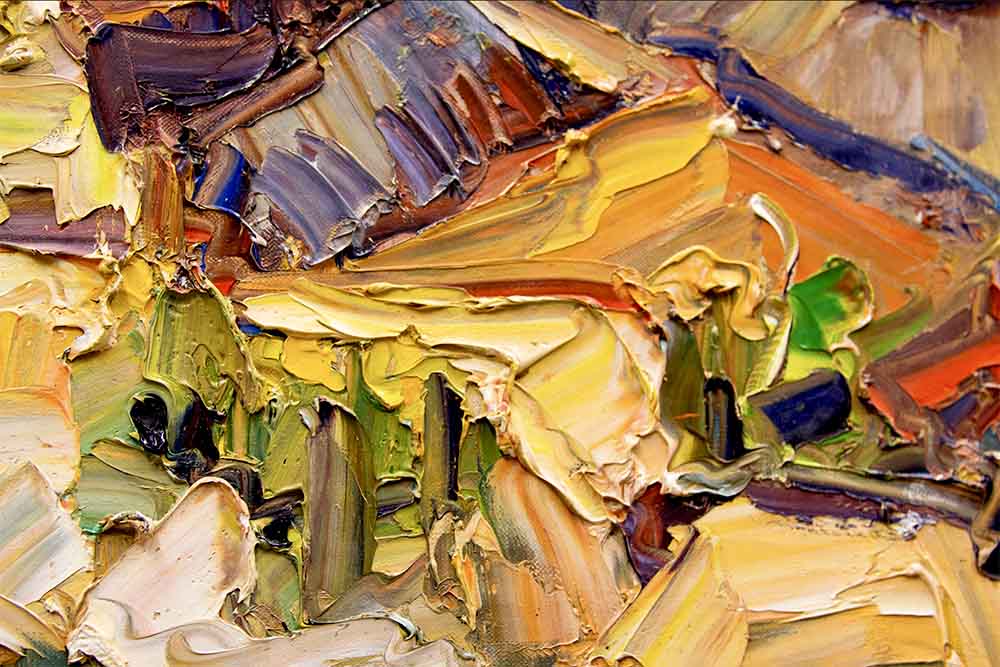
The distinctive vibrancy of Moroz’s expressionism is most fully attuned to his pursuit of nature’s inexhaustible motifs. When he is immersed in nature’s processes, his work attains its most eloquent voice. The symbiosis established by the artist between nature and his vigorous, dynamic brushstrokes and vibrant colors is sustained at a level of intensity that demands the viewer’s total involvement. We become witness to the transformation of nature into a brilliantly orchestrated interaction of colors, shapes, and brushstrokes that retain their identity as markings even as they suggest nature’s varied motifs. The ability of Moroz to orchestrate this process in an expansive expressive range, from quiet lyricism to dynamic bravura, evokes analogies to music like piano or fortissimo.

Jones Beach
1952, oil on canvas board
9 x 12 in. (22.3 x 30.5 cm)

Moroz’s deep commitment to the landscape tradition establishes the major continuities in his art. The impressive body of work in the exhibition, spanning nearly sixty years, underscores compelling links between early and later imagery. Seascapes from the coast of Maine from the 1960s and 1970s recall his early views of the Black Sea coast. His heroic views of the Colorado Mountains in works like Garden of the Gods (1965) have their counterpoints in his depictions of the Alps from the 1940s. Most importantly, his varied, brilliant views of the Catskill Mountains establish a deep bond with the early views of his beloved Kosmach region in the Carpathian Mountains.

Moroz’s art will always be most closely linked to his Ukrainian heritage. Yet it is important to appreciate the international scope of his vision. During his extensive career in America, for example, he painted many of the country’s most beautiful natural sites — from the coast of Maine to the Grand Canyon. These works represent his most mature expression. As such, he belongs among the preeminent American landscapists of the second half of the 20th century.

While the Moroz gift is comprised mainly of landscapes, it also includes some still-lifes and portraits. The imposing Guelder Rose (1980) is an outstanding manifestation of his still-life paintings.

Kufstein, Austria
1972, oil on canvas board
7 x 10 in. (17.8 x 25.4 cm)

The continuities in Moroz’s art are also evident in portraiture — most specifically in his self-portraits and the portraits of his wife. Throughout his career he painted his image, always as direct, honest, and self-probing. A selfportrait from 1946 in the exhibition is an excellent example of the way he addressed his physical and psychological self at every phase of his career. The many portraits of his wife, two of which are part of the gift to the Museum, are no less probing but always more elaborate. In the 1948 half-length portrait, she confronts the viewer directly with a forthright gaze, dressed in a Hutsul costume. The 1951 portrait, seen in three-quarter view, is more formally posed as she sits with her hands in her lap. The blue gown she wears is a contemporary example of 1950s fashion.

Florence, Italy
1967, oil on canvas board
6 x 10 in. (15.2 x 25.4 cm)

Although not included in the collection, perhaps the most meaningful continuity in Moroz’s portraiture is exemplified by his portrait of Metropolitan Andrei Sheptytsky, done early in his career in 1937, and a series of portraits of His Beatitude Patriarch Josyf Slipyj, which Moroz painted during his thirteen-month stay in Rome in 1973- 1974. The artist always felt it a special privilege to have painted portraits of the two preeminent religious leaders of Western Ukraine. To have been chosen for this honor at different times in his career is an affirmation of the artist’s sustained stature and talent. Moroz would validate this trust with every brushstroke of his extensive, eminent career.

Jaroslaw Leshko
Professor Emeritus of Art, Smith College


Exhibition Curator: Prof. Jaroslaw Leshko

Brochure —
Ukrainian translation: Maria Shust, Lubow Wolynetz
Edited by: Prof. Oleh Ilnytzkyj (Ukrainian); Romana Labrosse (English)
Graphic design: Maria Shust
Photography: Volodymyr Gritsik

© 2009 copyright of brochure by
The Ukrainian Museum, all rights reserved.


Pick up a (free) printed copy of the bi-lingual (English and Ukrainian) brochure at the Museum's admissions desk or download a PDF version (800K) to your computer.